



AGV Battery
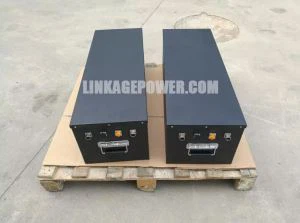
An AGV battery is a traction battery. It powers the electric motor that moves your vehicle. The batteries are AGV (Absorbed Glass Mat) or VRLA (Valve Regulated Lead Acid) batteries. They have no gas, fumes, or acid and are completely sealed. They can be charged and discharged thousands of times. The AGV battery is made using glass mats or fiberglass plates between lead-acid cells inside a heavy rubber container. This type of battery uses a valve system to relieve pressure as it charges to handle more charge cycles without breaking down.
Advantages of AGV Battery
Increased safety
AGV’s are fitted with sensors and guidance systems that allow them to make their way through a facility without colliding with any other objects. Once it detects the presence of an object along its path, it comes to a complete stop. A manually operated vehicle is reliant on a driver for navigation.
Increased accuracy
The advantages of automated guided vehicles do not stop with increased safety. With a programmed route and the aid of sensors, the AGV can pick up and offload materials without breaks, slip-ups, or miscalculations.
Scalable
Whenever you introduce change in your business, it’s best to do it gradually. In this way, you learn how to optimize the AGV and make changes to integrate the technology.
Maneuvers easily
An AGV follows a predetermined route around the facility without deviating from its path. AGV’s use different guidance systems depending on the model specified.
Advancement
The AGV lithium battery pack car integrates light, machine, electricity and computer, and integrates the advanced theory and application technology in the field of science and technology. It has strong guiding ability, high positioning accuracy and good automatic driving performance.
Fast action
The AGV lithium battery pack car is characterized by wheeled movement. Compared with walking, crawling or other non-wheeled mobile robots, it has fast action, high work efficiency, simple structure, strong controllability, and good safety.




Why Choose Us
High quality
Our products are manufactured or executed to a very high standard, using the finest materials and manufacturing processes.
Advanced equipment
A machine, tool or instrument designed with advanced technology and functionality to perform highly specific tasks with greater precision, efficiency and reliability.
Professional team
Our professional team collaborates and communicates effectively with each other, and is dedicated to delivering high quality results. We are capable of handling complex challenges and projects that require our specialized expertise and experience.
Long warranty
We are confident in the quality of our products and are willing to provide you with long-term technical service support.
One-stop solution
At our manufacturing facilities, we provide a complete package that includes everything required to get you started, including training, installation and support.
24H online service
We try and respond to all concerns within 24 hours and our teams are always at your disposal in case of any emergencies.
Technical Progress of AGV Battery
The rise of warehouse automated guided vehicles (AGVs) has been facilitated by advancements in battery technology. The advancement in battery technology has led to increased efficiency of the AGVs that power an OEMs (original equipment manufacturers) warehouse. It is no exaggeration to say that the battery pack is the heart of the AGV, without the battery the AGV doesn’t function. The battery packs provide the power needed to drive the AGV’s motors, sensors, and other components. Our engineers can design the perfect battery for your automated guided vehicle to perform its task, a key design decision is always the power storage capability of the battery pack. The power storage system in the battery pack is what allows the AGVs to operate continuously in warehouse environments. May want their AGVs to operate for a long time between charges, therefore we would design the battery pack to have high power storage capabilities. Our expert engineers can design your pack with a smart BMS (battery management system) to enable your pack to be fast charging. This system will enable rapid battery replenishment during short breaks or between tasks, minimising your guided vehicles downtime. This ensures that your guided vehicle is available for as much of their working hours as possible. Alongside fast charging capabilities, our engineers can use energy-dense cells to formulate your pack. This reduces the frequency of recharging, thus maximizing the AGV’s productivity to provide greater results.The battery packs is attributed as a significant portion of the AGV’s weight, therefore it’s crucial the pack is as light as possible to allow the battery pack to perform efficiently. A lighter design will help optimise the guided vehicles payload capacity. Our engineers have had experience designing ultra-lightweight packs whilst still being in a suitably robust casing. To ensure your battery pack is maintained properly, an integrated BMS can monitor and manage battery health, charge, cycles and temperature. These additions can help ensure the battery packs longevity and health. That make the switch to AGVs will gain a competitive advantage over their competitors due to the increased efficiency provided by an automated fleet. Although there is an initial large outgoing expense, the return on investment (ROI) will be ongoing due to the lengthy usage amount you will obtain from AGVs. Increased efficiency with 24/7 capabilities with the correct battery pack design. Greater consistency and accuracy due to the precise paths AGVs are placed on. Flexibility of tasks, with an ultra-lightweight battery pack an AGV can handle both heavy and light payloads with the same efficiency. Cost savings through eliminating the need to pay for human manual labor.


How Does an AGV Battery Work?
The AGV battery is an innovative alternative to traditional fuel-powered vehicles. The AGV battery is powered by electricity and does not produce fumes. It is lighter than a standard car battery, and it can be recharged by plugging the vehicle into a wall outlet. The AGV battery has many important features that make it ideal for electric vehicles. AGV batteries store the charge more efficiently than lead-acid batteries. In other words, they can generate much more power per unit weight. AGV batteries can be charged in about one hour instead of lead-acid, which takes about three hours to recharge. AGV batteries are made from recyclable materials, unlike their counterparts, lead-acid. An AGV battery works just like a traditional car battery. They provide power to your vehicle's electric motor to move without using gas or fumes! But an AGV battery has many benefits that make it a better choice than its counterpart lead-acid (or "SLA"). It's lighter than SLA or leads acid as it's made of recyclable material instead of heavy lead plates. In order to explore whether or not your AGV battery needs to be replaced, you should consider how many years it has been since you replaced the battery. The age of a battery can be determined by looking at the date code on the bottom of the battery. If you have had your vehicle for more than 5 years, the battery is more likely to need replacing. An AGV battery only lasts for about 4-5 years, and if you have had your car for 5 years, it is time to change out your AGV batteries before they die completely. An AGV battery is used in various industrial applications to power a variety of machines. AGV batteries are typically used in forklifts, electric vehicles, and more. AGV batteries are used in various applications, so it's important to know how to care for an AGV battery.
AGV Battery Performance and Safety
Agv battery is self-guiding vehicle batteries,Before the logistics handling is pure manual handling or manual operation of the machine handling, the emergence of AGV lithium battery car, began to gradually replace the edge of some handling. Compared with manual handling, AGV has many advantages, such as higher work efficiency, high reliability, high safety and saving management effort.AGV has preset routes in the working environment. The autonomous mobile robot (AMR) can adjust its course in a preset working environment. lithium ion battery for agv Performance and Safety Testing Lithium solutions provide power and energy density, fast charging, and intelligent balance system integration capabilities that oems need to meet industry-leading design goals, performance and productivity requirements of AGV/AMR equipment suppliers and equipment owners. As the power energy of AGV car, AGV battery generally adopts 24V or 48V DC power supply. It needs to have the advantages of many cycles of charge and discharge, low self-discharge rate, long service life, strong deep discharge ability, high charging efficiency, strong power, strong seismic ability, little maintenance or maintenance-free. At present, AGV car agv lithium ion battery useful to lithium iron phosphate battery and three lithium battery two categories.The optimal AGV battery depends on the agv lithium battery charging system chosen. Charging technology defines optimal technical and economic solutions. AGV batteries, Lithium iron phosphate batteries and ternary lithium batteries have almost completely replaced the nickel-cadmium batteries and nickel-hydrogen batteries in the past.

Misunderstandings About AGV Battery
Reduce charging times, can prolong the life of the AGV battery. Typically, AGV batteries have a lifetime of several hundred charge-discharge cycles. The charge-discharge cycle here refers to the process of using up the battery and then recharging it. Lithium battery has no memory effect, can be charged at any time, in order to reduce the number of charges deliberately used up after the battery is fully charged, does not prolong the battery life, but has a negative impact on the battery life. Overcharging will cause AGV battery explosion. Lithium battery has safety protection circuit and a variety of safety devices, so it can ensure. In the excessive charge and discharge or short circuit, automatically cut off the battery circuit; When the internal pressure of the battery is too high, the exhaust device is triggered to decompress; When the battery temperature is too high, the hot melt protection device is triggered to stop the electrochemical reaction of the lithium iron phosphate battery. So, unless there is a quality problem, the AGV battery will not explode due to a long time of charging. However, if the battery is fully charged and not unplugged, the battery will remain fully charged, which will not explode, but will accelerate the rate of battery loss. Different AGV battery products need different ways to charge, must strictly follow the product instructions to use. Nickel-cadmium and nickel-metal hydride batteries used to require similar “activation,” but in today’s lithium-ion batteries, the initialization process is already complete at the time of manufacture. Autonomous Guided Vehicles (AGV) are capable of performing high-volume, repetitive tasks in tough and demanding work environments — longsing’s lithium-ion batteries, charging solutions and systems are ready to take on the challenge.
How to maintain AGV Battery
At present, with the rapid development of various industries, the demand for AGV lithium battery has increased significantly, and many enterprises are facing difficulties in recruitment. The emergence of AGV industrial robots has provided an effective and powerful needle for relevant industries, saving labor costs and creating more value. As we all know, THE power of AGV comes from batteries. With the continuous release of AGV demand, the AGV lithium batteries market has developed into a arable land. Currently, many AGVs or transport robots use lithium batteries as a power source.In order to timely understand the status of AGV lithium battery and ensure their normal operation, the batteries must be regularly checked and maintained. First, use a multimeter to measure the open-circuit voltage of agv lithium ion battery regularly every month, 12.8V is the standard value, if the single battery is higher than 12.8V is normal, if it is lower than the standard value, it is necessary to charge the battery in time. Every three months check whether the lithium battery is damaged, whether there is leakage between the shell and cover, if there is leakage should find out the reason. Whether there is dust on the surface and cracks on the shell cover should be replaced in time. If there is dust, wipe it with a wet cloth. Check the connector for rust. Lithium batteries must be removed from the AGV cart and stored separately. When storing lithium batteries, it is recommended to avoid placing the batteries outdoors, under low temperature or adverse conditions, and place them in dry and ventilated areas as far as possible. Use professional original matching charging adapter to charge agv car battery to prevent battery life loss or unnecessary safety risks caused by mismatching of battery and charger.
Factors to Consider When Choosing AGV Battery
AGVs mainly use lead-acid batteries, nickel-metal hydride batteries and lithium-ion batteries as their battery types. It is a more traditional battery type with relatively low cost and good reliability. However, lead-acid batteries are heavier and larger, take longer to charge, and are more cumbersome to maintain. Lithium-ion batteries have become the mainstream choice for AGVs due to their higher energy density, smaller size and weight. It has a long charging life, low self-discharge rate and high charging efficiency, while there is no memory effect. Compared with lead-acid batteries, NiMH batteries have higher energy density and lighter weight, shorter charging time and are environmentally friendly. However, it is relatively expensive and has certain self-discharge problems.Lithium Iron Phosphate Battery: Lithium Iron Phosphate battery is getting more and more attention in AGV. It has high safety, long cycle life and wide operating temperature range. Compared with other lithium-ion batteries, Lithium Iron Phosphate Battery has lower heat generation and faster charging speed. In addition, the capacity of AGV battery is usually between 5Ah and 200Ah, depending on the vehicle’s load, traveling distance and working time and other factors. In order to meet different application requirements, AGVs are usually equipped with multiple battery modules, which can be combined in parallel and series to realize the required capacity and voltage. It is necessary to take into account the rated value voltage and maximum voltage of the output terminal, and clarify the voltage and raw material of the lithium battery. The rated value voltage of the battery cannot be less than the rated value voltage of the motor. The full-scale electric voltage of the battery can not be higher than the maximum voltage of the machine and equipment. The common voltage of AGV on the market is 24V, 48V, 72V. We can provide a wide range of battery sizes and configurations, for those specific power requirements of the application, we can provide assistance with the design, development, testing, and manufacture of customized battery solutions, testing, and manufacture of customized battery solutions to meet the specific needs of virtually any application.
Our Factory
We have first rate production line, the professional engineers working with us, Grade A BMS technology, which makes the battery pack with safety and long recycling life.Military Lithium batteries, e bike battery, vehicle batteries, golf cart battery, starter battery,Military, underwater machine, subsea marine, solar storage E bike, Electric vehicle, Medical. Automatic soldering machine, ultrasonic wave shielding machine.

Certificate

FAQ
Q: What is an AGV battery?
Q: What types of batteries are used in AGVs?
Q: How long do AGV batteries last?
Q: How do AGV batteries work?
Q: Can AGV batteries be recharged?
Q: Can AGV batteries be replaced?
Q: Can AGV batteries be recycled?
Q: What is the capacity of AGV batteries?
Q: What is the voltage of AGV batteries?
Q: What is the energy density of AGV batteries?
Q: What is the power output of AGV batteries?
Q: What is the future of AGV batteries?
Q: What is the weight of AGV batteries?
Q: What is the charging time for AGV batteries?
Q: What is the operating temperature range for AGV batteries?
Q: What is the discharge rate for AGV batteries?
Q: What is the cycle life of AGV batteries?
Q: What is the self-discharge rate for AGV batteries?
Q: What is the cost of AGV batteries?
Q: What is the maintenance required for AGV batteries?